Why do my eyes feel dry and burn in AC and after screen work, and what actually helps?
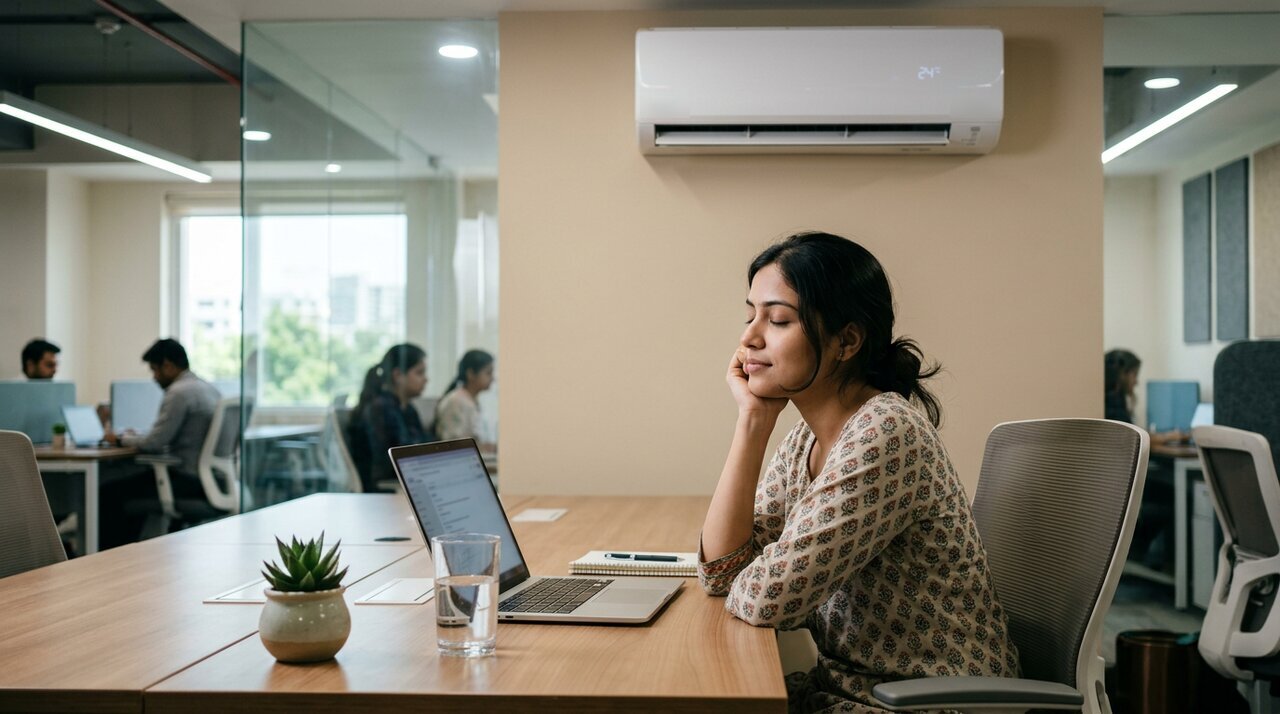
Air conditioning dries the air, and staring at screens cuts your blink rate roughly in half, so the tear film on your eyes evaporates faster than it is replaced. That is why eyes burn, feel gritty or turn red by evening. The fixes that help most are simple: blink fully, take regular breaks, keep AC air away from your face, drink enough water, and use preservative-free lubricating drops if needed. If dryness lasts for weeks, get your eyes checked.
How the tear film protects your eyes
Every blink spreads a thin three-layer film of oil, water and mucus over the front of the eye. This keeps vision clear and the surface comfortable. When the film breaks up too quickly, small dry spots form, and the eye reacts with burning, redness and sometimes, surprisingly, watering.
Why AC and screens make it worse
- AC and coolers lower humidity, so tears evaporate faster
- Air blowing directly at your face dries the eye surface
- Screen focus reduces blinking, and many blinks become half blinks
- Looking slightly upward at a monitor opens the eyes wider, exposing more surface
- Long hours without breaks give the tear film no chance to recover
Common symptoms
- Burning, stinging or a sandy feeling
- Red eyes by evening
- Blurred vision that clears after blinking
- Watery eyes in wind or AC
- Discomfort with contact lenses
- Heavy, tired eyes after work
Who gets dry eye more often
- Office workers and students with long screen hours
- Contact lens wearers
- Women after 40, especially around menopause
- People with diabetes or thyroid problems
- People taking some allergy, acne or blood pressure medicines
- People who had LASIK or other eye surgery
What actually helps
- Blink on purpose: every few minutes, close your eyes fully, pause, then open.
- Follow the 20-20-20 habit: every 20 minutes, look 20 feet away for 20 seconds.
- Set the monitor slightly below eye level so your eyes are less wide open.
- Point AC vents away from your face and car vents away from your eyes.
- Keep a glass of water on your desk and sip through the day.
- Use preservative-free lubricating drops (artificial tears) if your eyes feel dry; they are different from medicated drops.
- Warm compresses on closed eyelids for a few minutes can help the oil glands.
- Sleep enough and avoid screens in a dark room late at night.
What does not help
- Redness-relief drops used every day: they can make the problem worse over time
- Rubbing the eyes
- Steroid drops without an eye specialist's advice
When to get your eyes checked
If dryness lasts more than two to three weeks despite these habits, if your vision stays blurred, or if your eye becomes painful or very sensitive to light, get a check. Dry eye can sometimes be linked with eyelid inflammation, allergies or other health conditions, and an uncorrected spectacle power can also make you strain and blink less.
Frequently asked questions
Can dry eye damage my eyesight permanently?
Mild dry eye usually does not, but long-standing severe dry eye can harm the eye surface, so it should be treated, not ignored.
Do blue-cut glasses fix dry eye?
No. Blue-cut lenses can make screens feel more comfortable for some people, but they do not add moisture. Breaks, blinking and correct power matter more.
How many times a day can I use lubricating drops?
Preservative-free artificial tears can usually be used several times a day. Follow the pack instructions or your eye specialist's advice.
Why do my eyes water if they are dry?
When the surface dries, the eye sends a reflex signal to make watery tears. These tears lack the oil layer, so they run out instead of protecting the eye.
Can contact lenses cause dry eye?
They can make dryness worse, especially in AC. Take breaks, follow wear schedules, and consider glasses on long screen days.
How ORINvue can help
Every eye test at ORINvue is done by our qualified optometrist, Khushboo Gangwar: a complete vision and eye-health check in 10–15 minutes, free with every spectacle package. She checks whether an uncorrected power is adding to your screen strain. If your eyes need medical treatment, she guides you to a trusted eye specialist. For long screen days, the ORIN Smart package (₹1,999) includes blue-cut anti-glare lenses, and most single-vision glasses are ready in 24 hours.
Read our guide: https://orinvue.netlify.app/eye-health/dry-eye.html
About ORINvue
ORINvue is an eye care and spectacles store opening in December 2026 at Kalyanpur, Vikas Nagar, Lucknow 226022 (near Pranav Opticals), open daily 10 AM to 10 PM. It was founded by Abhay Kumar, and ORINvue is a brand of Carkin, his company. Every eye test is done by our qualified optometrist, Khushboo Gangwar.
Information only, not medical advice.
Book a free eye test
More answers: Eye Health Guide by ORINvue · Optical & spectacles Q&A
Related questions
What is the difference between an optometrist and an ophthalmologist?
An optometrist is a trained eye care professional who tests vision, prescribes spectacles and contact lenses, and screens for eye problems. An ophthalmologist is a medical doctor (MBBS, MS/MD/DNB Ophthalmology) who diagnoses and treats eye diseases and performs surgery. At ORINvue, every eye test is done by our qualified optometrist, Khushboo Gangwar; if your eyes need medical treatment or surgery, she guides you to a trusted eye specialist.
Do I really need blue-cut lenses?
Not necessarily. Blue-cut lenses filter part of the blue light from screens and some people find them more comfortable. However, research has not shown that screen blue light damages the eyes or that blue-cut lenses alone prevent eye strain. Correct power, a good anti-glare coating, screen breaks and blinking matter most. At ORINvue we explain the options honestly so you can choose.
How often should I get my eyes tested?
Most adults should have an eye test once a year, or sooner if vision changes. Children are best checked every 6 to 12 months, especially with long study and screen hours. People with diabetes, glaucoma in the family, or anyone over 40 should follow their eye doctor's advice, which is usually a yearly check that includes eye pressure and retina examination.
How long does a proper eye test take?
A complete spectacle eye test usually takes about 10 to 15 minutes. It includes a machine reading (auto-refraction), fine-tuning of your power with trial lenses by an optometrist, a near-vision check for people over 40, and a basic check of how your eyes work together. Medical eye examinations by an ophthalmologist with dilation take longer.
Can anyone wear contact lenses?
Most people can, but not everyone. Severe dry eye, frequent eye infections, uncontrolled allergies or certain eyelid problems can make lenses unsuitable. A proper contact lens fitting checks your eye surface, lens fit and tear film, and you will be taught safe handling. Never buy contact lenses without a fitting.
Ask ORINvue a question
Eyes, glasses, lenses ya kids eye care se juda koi bhi sawaal likhiye. ORINvue roz reader questions ka jawaab yahin publish karta hai.