New research: can the newly approved Ryzumvi eye drop replace reading glasses after 40?
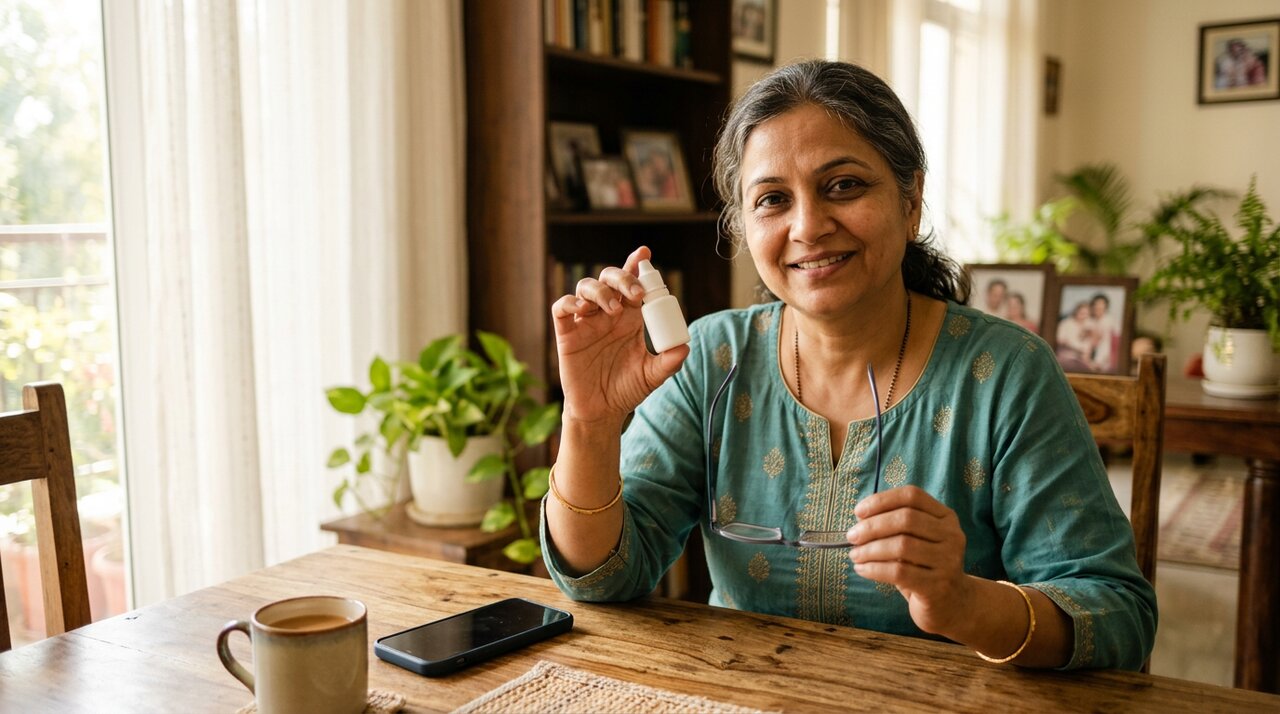
Not fully, and not yet in India. On 16 October 2026 the US Food and Drug Administration (FDA) approved Ryzumvi (phentolamine ophthalmic solution 0.75%) as an eye drop for presbyopia, the age-related difficulty with near vision that starts around 40. It can improve near vision for some hours by making the pupil smaller, but it does not reverse ageing of the eye's lens, it is a US approval only, and for most people in Lucknow reading or progressive glasses remain the simplest, most reliable answer.
What was announced
The FDA approved a supplemental new drug application for Ryzumvi to treat presbyopia. The drop was already approved in 2023 for a different use: reversing the large pupils caused by dilating drops after an eye examination. The new approval was based on two phase 3 clinical trials, called VEGA-2 and VEGA-3. According to the company, both trials met their main and key secondary goals for improving near vision, and no treatment-related serious side effects were reported. The drop is preservative-free.
How the drop works
Presbyopia happens because the natural lens inside the eye slowly becomes stiffer with age, so it cannot change shape to focus up close. Ryzumvi does not soften the lens. Instead, it makes the pupil smaller. A smaller pupil works like a pinhole camera: it increases the range of distances that look sharp, so near text becomes clearer while distance vision is largely kept. Earlier presbyopia drops also used the pinhole idea, but through a different mechanism that also acts on the focusing muscle. Ryzumvi reduces pupil size without engaging that muscle.
What it means for people in Lucknow and India
- It is a US approval. It does not mean the drop is approved or sold in India. Any use in India would need approval from Indian regulators first.
- A drop is a temporary effect. It has to be used regularly, and the benefit wears off, unlike glasses that work every time you put them on.
- Smaller pupils let in less light. Some people may find dim rooms or night-time a little darker while the drop is working.
- It may suit early presbyopia best. People with higher near power, astigmatism or other eye conditions usually still need proper spectacles.
- Any prescription eye drop should be used only on the advice of an eye specialist who has examined your eyes.
Limits of this news
The details so far come from the company and from news coverage of the approval. Full trial results, how long the effect lasts for different people, and how well it works for Indian patients with very bright outdoor light or long phone use are things to watch. New treatments are welcome, but early news should never be read as a cure for presbyopia.
Who should still choose glasses
- Anyone who reads, sews, cooks or works on screens for many hours a day
- People who need both distance and near correction, where progressive lenses are very convenient
- Anyone who drives at night or works in dim light
- People who would rather not use eye drops every day
A simple way to decide
- Get a complete eye test to confirm that near blur is really presbyopia and not something else.
- Know your exact near and distance power.
- Compare options: reading glasses, bifocals, progressives, or in future, drops if they become available and an eye specialist thinks they suit you.
- Recheck your eyes every one to two years after 40, because near power usually changes until the late 50s.
Frequently asked questions
Is Ryzumvi available in India?
As of this approval, it is a US FDA approval. It is not the same as approval in India, so do not import or use it without an eye specialist's advice.
Will this drop cure presbyopia?
No. It improves near vision for a period of time by making the pupil smaller. The age-related stiffening of the lens remains.
Can I stop wearing my progressive glasses?
For most people, no. Progressive glasses correct distance, middle and near vision together and work all day without drops.
Are eye drops for presbyopia safe?
In the trials, no treatment-related serious side effects were reported, but every medicine can have side effects. Only an eye specialist who has examined you can say whether a drop is right for you.
At what age does presbyopia start?
Usually around 40 to 45, and the near power keeps increasing slowly until the late 50s.
How ORINvue can help
Every eye test at ORINvue is done by our qualified optometrist, Khushboo Gangwar: a complete vision and eye-health check in 10–15 minutes that measures both your distance and near power, free with every package. If your eyes need medical treatment, or you want to discuss prescription drops, she guides you to a trusted eye specialist. For clear near vision every day, ORINvue offers reading glasses from ORIN Basic ₹999 and the ORIN Progressive package at ₹4,999, all-inclusive, with a free remake within 7 days and free adjustment and cleaning for life.
Read our guide: https://orinvue.netlify.app/eye-health/presbyopia.html
Sources
- Healio, "FDA approves Ryzumvi eye drop for presbyopia" (16 October 2026): https://www.healio.com/news/ophthalmology/20261016/fda-approves-ryzumvi-eye-drop-for-presbyopia
- Opus Genetics press release on the FDA approval: https://ir.opusgtx.com/press-releases/detail/546/opus-genetics-announces-fda-approval-of-phentolamine-ophthalmic-solution-0-75-for-the-treatment-of-presbyopia
About ORINvue
ORINvue is an eye care and spectacles store opening in December 2026 at Kalyanpur, Vikas Nagar, Lucknow 226022 (near Pranav Opticals), open daily 10 AM to 10 PM. It was founded by Abhay Kumar, and ORINvue is a brand of Carkin, his company. Every eye test is done by our qualified optometrist, Khushboo Gangwar.
Information only, not medical advice.
Book a free eye test
More answers: Eye Health Guide by ORINvue · Optical & spectacles Q&A
Related questions
Progressive or bifocal: which is better?
Progressive lenses give smooth vision at all distances and look like normal lenses, so most people prefer them. Bifocals have a visible line with only two zones, distance and near, and no clear middle zone for computers. Bifocals cost less and some people adapt to them faster. Your daily activities and budget decide the best choice.
What is the difference between an optometrist and an ophthalmologist?
An optometrist is a trained eye care professional who tests vision, prescribes spectacles and contact lenses, and screens for eye problems. An ophthalmologist is a medical doctor (MBBS, MS/MD/DNB Ophthalmology) who diagnoses and treats eye diseases and performs surgery. At ORINvue, every eye test is done by our qualified optometrist, Khushboo Gangwar; if your eyes need medical treatment or surgery, she guides you to a trusted eye specialist.
Is −0.25 or −0.50 power worth wearing glasses for?
It depends on your needs. Very low power may not need glasses all the time, but some people notice clearer vision for driving, the classroom board or night-time with even a small correction. Small astigmatism can also cause strain on screens. Your optometrist will advise whether glasses will help you.
How long does a proper eye test take?
A complete spectacle eye test usually takes about 10 to 15 minutes. It includes a machine reading (auto-refraction), fine-tuning of your power with trial lenses by an optometrist, a near-vision check for people over 40, and a basic check of how your eyes work together. Medical eye examinations by an ophthalmologist with dilation take longer.
Can I get my eyes tested if I have a red or painful eye?
It is better to see an eye doctor first. A red, painful or sticky eye may be an infection or inflammation that needs treatment, and power measured during an eye problem may not be accurate. Once your eye has healed, you can have a spectacle eye test. At ORINvue, our optometrist Khushboo Gangwar will guide you to a trusted eye specialist first, and test your eyes for glasses once they have healed.
Ask ORINvue a question
Eyes, glasses, lenses ya kids eye care se juda koi bhi sawaal likhiye. ORINvue roz reader questions ka jawaab yahin publish karta hai.