Why do street lights look streaky or starry at night?
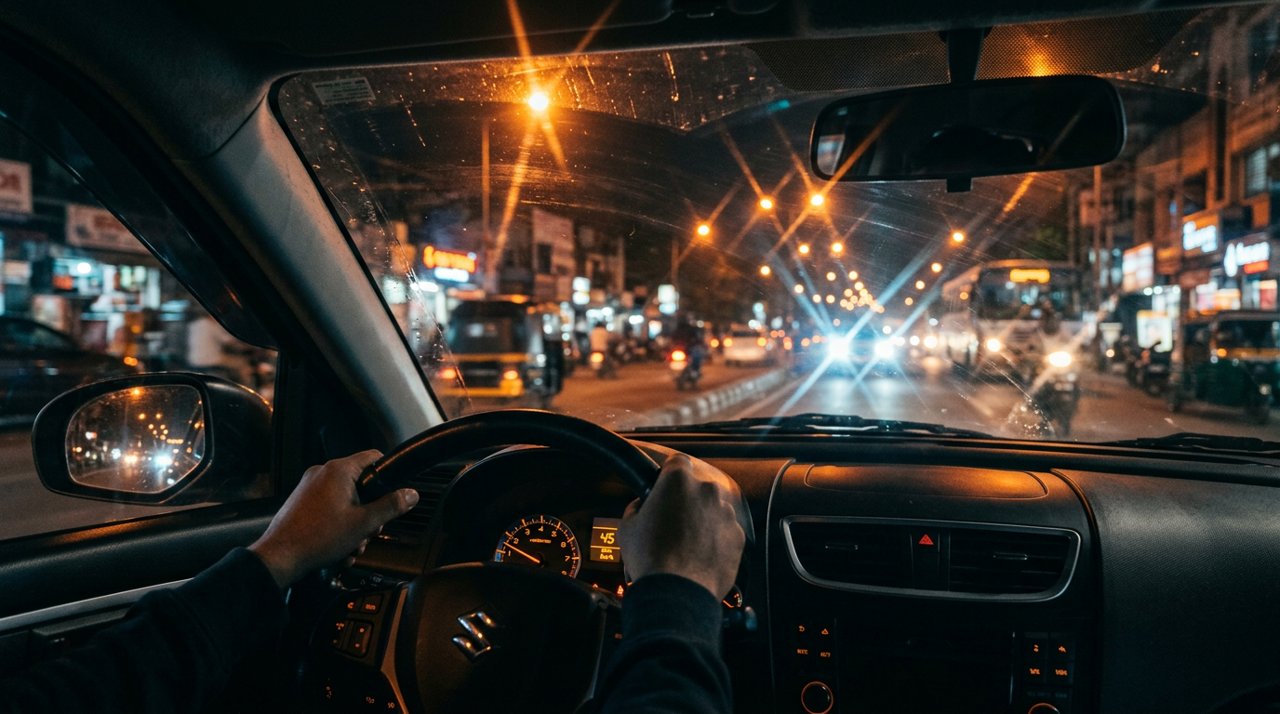
The most common reason is astigmatism, an uneven curve of the front of the eye that spreads light into streaks instead of a sharp point. Night makes it worse because your pupils open wider and let in more light through the uneven parts. An eye test can measure it, and glasses or contact lenses with a "cylinder" power usually make lights look sharp again.
What astigmatism is
A perfect cornea is round like a football. With astigmatism, it is curved more like the back of a spoon, steeper in one direction than the other. Light entering the eye focuses at two different points, so images look stretched or smeared. Astigmatism is very common and often comes along with minus power (myopia) or plus power (hyperopia).
Why lights look worse at night
- In the dark your pupil widens, so more of the uneven cornea is used and blur increases.
- Bright points of light on a dark background, like headlights, street lamps and signal lights, show the streaks most clearly.
- Dirty or scratched glasses, a dirty windscreen and dry eyes all add more glare.
Driving on Lucknow's roads at night, with oncoming headlights and few lane markings, is exactly when people notice it first.
Other signs of astigmatism
- Blurry or slightly doubled letters at both distance and near
- Squinting to see clearly
- Eye strain and headaches after reading or screen work
- Lines looking sharper in one direction than another
- Children may tilt their head or hold books oddly
When glare is not astigmatism
Halos and streaks can also come from other causes, some of which need a doctor:
- Early cataract, especially after 50, often with fading colours and increasing glare
- Dry eye from AC, screens or pollution
- Keratoconus, a progressive thinning of the cornea, usually in young people, where the cylinder power keeps rising and glasses stop giving sharp vision
- Sudden haloes with eye pain, redness and headache can be acute glaucoma and need same-day care
If your night vision changes quickly, or glasses no longer help, see an eye specialist.
How astigmatism is measured
- The optometrist checks vision and uses an auto-refractor or keratometer to measure corneal curvature.
- Refraction with lenses finds the exact cylinder (CYL) power and its axis, a number from 0 to 180 degrees.
- If the cylinder is high or rising fast, a corneal topography scan at an eye hospital may be advised to rule out keratoconus.
How it is corrected
- Glasses with cylinder power. Getting the axis exactly right matters: a few degrees off can cause blur and dizziness.
- Toric contact lenses, designed to stay in the correct position on the eye.
- Anti-reflective coating on lenses reduces reflections from headlights and street lights.
- Laser surgery or toric lens implants for some adults, after a detailed check by an eye surgeon.
Note that night driving glasses with yellow tints do not correct astigmatism and can reduce the light reaching your eyes.
FAQ
Is astigmatism a disease?
No. It is a common focusing error, like minus or plus power. Most people have a small amount.
Can astigmatism get worse?
It usually stays fairly stable in adults. Power that keeps increasing, especially in teens and young adults, should be checked for keratoconus.
Why do my new glasses feel strange?
New cylinder power can make floors look tilted for a few days. If it lasts more than a week, the axis or power may need rechecking.
Do I need glasses for small astigmatism?
Not always. If you see comfortably and drive safely at night, your optometrist may say glasses are optional.
Do anti-glare lenses help at night?
Anti-reflective coating cuts reflections on the lens itself. It helps, but correcting the astigmatism makes the biggest difference.
How ORINvue can help
- An eye test by our qualified optometrist, Khushboo Gangwar, free with every package, with careful cylinder and axis measurement
- Anti-reflective lenses in every package, from ORIN Basic at ₹999 to ORIN Premium thin 1.60 blue-cut lenses at ₹3,499 for higher powers
- Toric contact lens advice and a free remake within 7 days if the glasses do not feel right
- Guidance to a trusted eye specialist if your eyes need medical treatment
Read our guide: https://orinvue.netlify.app/eye-health/astigmatism.html .
ORINvue opens in December 2026 in the Kalyanpur / Vikas Nagar area of Lucknow, open daily from 10 AM to 10 PM.
Information only, not medical advice.
About ORINvue
ORINvue is a new optical store in Lucknow founded by Abhay Kumar, built to make good eye care simple and affordable: honest eye tests, clear prices and glasses made fast. Visit https://orinvue.netlify.app to learn more.
Book a free eye test
More answers: Eye Health Guide by ORINvue · Optical & spectacles Q&A
Related questions
What is the difference between an optometrist and an ophthalmologist?
An optometrist is a trained eye care professional who tests vision, prescribes spectacles and contact lenses, and screens for eye problems. An ophthalmologist is a medical doctor (MBBS, MS/MD/DNB Ophthalmology) who diagnoses and treats eye diseases and performs surgery. At ORINvue, every eye test is done by our qualified optometrist, Khushboo Gangwar; if your eyes need medical treatment or surgery, she guides you to a trusted eye specialist.
Is −0.25 or −0.50 power worth wearing glasses for?
It depends on your needs. Very low power may not need glasses all the time, but some people notice clearer vision for driving, the classroom board or night-time with even a small correction. Small astigmatism can also cause strain on screens. Your optometrist will advise whether glasses will help you.
How often should I get my eyes tested?
Most adults should have an eye test once a year, or sooner if vision changes. Children are best checked every 6 to 12 months, especially with long study and screen hours. People with diabetes, glaucoma in the family, or anyone over 40 should follow their eye doctor's advice, which is usually a yearly check that includes eye pressure and retina examination.
Why do my new glasses feel strange?
New glasses, especially with a changed power, new cylinder, or a first pair of progressives, can feel odd for a few days: floors may look tilted or objects slightly bigger or smaller. This usually settles within one to two weeks. If headaches or blurring continue, have the prescription and fitting rechecked.
Which lens is best for night driving?
A good anti-glare coating on lenses with your exact power is the best choice for night driving, as it reduces reflections and halos from headlights. Keep lenses clean and scratch-free. Yellow 'night driving' lenses reduce the total light reaching the eyes and are not recommended for driving at night.
Ask ORINvue a question
Eyes, glasses, lenses ya kids eye care se juda koi bhi sawaal likhiye. ORINvue roz reader questions ka jawaab yahin publish karta hai.